
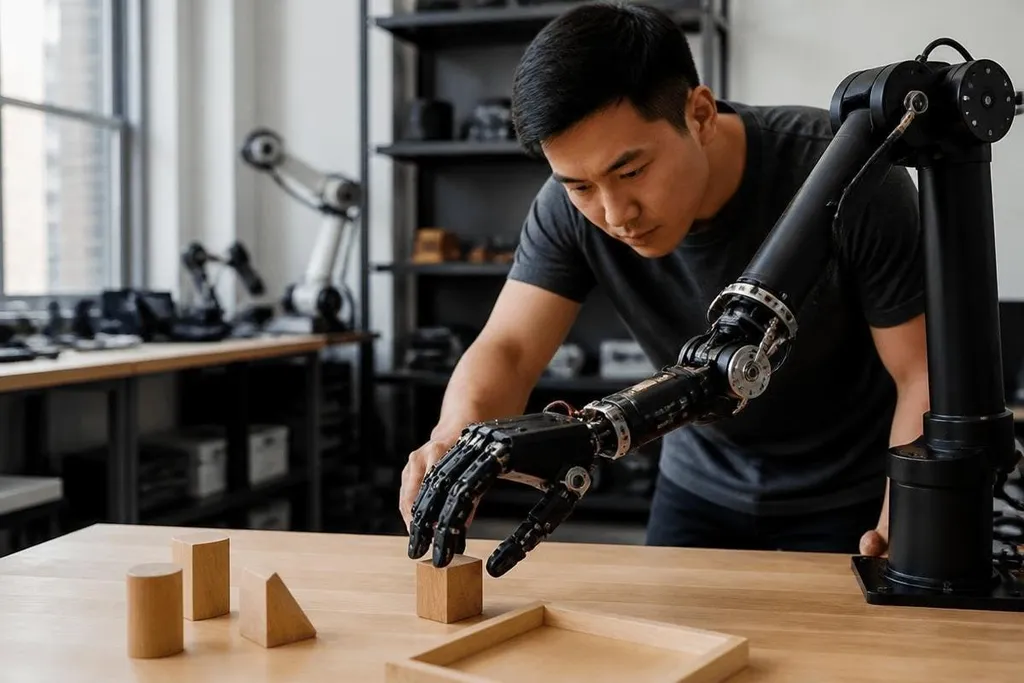
A robotic limb can move through a set path and still fail at the task that matters. The hard problem is control: sensing an object, choosing a safe motion, and adjusting when contact changes.
This matters to engineers building prosthetic arms, robot hands, and industrial manipulators. A smarter limb must respond to the world in front of it, not only repeat commands from software.
- Better sensing should help a limb detect contact and pressure.
- Better control should let it change motion during a task.
- Better tests should show where the system still fails.
What “smarter” means in a limb
A robotic limb usually combines motors, joints, sensors, and software. The motors create movement, while sensors report position, force, speed, or contact. The software turns those readings into the next motion.
That loop runs again and again. If a gripper touches a cup sooner than expected, the limb needs to reduce force or change its grip. A fixed motion may crush the cup, drop it, or stop short.
For a prosthetic arm, the problem has another layer. The system must read a person’s intent from signals such as muscle activity or a control switch. It then needs to turn that input into a motion that feels predictable to the wearer.
Predictability matters more than a long list of motions. A user may prefer a hand that performs four tasks reliably over one that claims dozens of modes but often chooses the wrong grip.
Why the race is difficult
The hardware has to fit inside tight limits. A limb needs motors with enough torque, batteries that last through a useful work period, sensors that keep working after contact, and joints that can survive repeated loads.
Adding more parts can create new problems. More sensors produce more data, but the software must read that data quickly enough to guide the movement. More joints can give the limb extra reach, while also making control harder.
That trade-off changes with the job. A prosthetic hand needs low weight, quiet movement, and control that a person can learn. A factory arm may need repeatable placement, force control, and a fixed connection to other equipment.
The word “smart” covers too much. A limb that identifies an object in a clean demonstration may still struggle with glare, loose fabric, dust, or an object placed at an odd angle.
A polished grasp can hide failures that appear when the limb meets glare, fabric, dust, or odd angles. Use Robot24 to check the maker, test setting, task, and date before judging a lab result as progress toward daily use.
The test is harder than the demo
A useful test starts with the task, not the software label. It should state what the limb must lift, how often it must repeat the motion, and what happens when the first attempt fails.
Force is one test point. A limb may need enough force to hold an object, but less force when the object is soft or fragile. Speed is another. A fast movement has little value if the limb cannot stop safely after contact.
The test should also include setup time and human input. If a technician must tune every motion by hand, the system may work well in one cell but take too long to move to another.
If a prosthetic user needs many hours to learn a control scheme, that time belongs in the product assessment.
The open problem is general use. A limb may perform well with known objects and fixed lighting, then lose accuracy when the scene changes. Until makers publish failure rates across more than one task, claims about smarter control remain incomplete.
A buying and testing checklist
Before you compare a robotic limb, check these points:
- Name the task: define the object, motion, load, and success condition.
- Check the sensors: find out what the limb measures and how often it updates.
- Ask about force: look for limits during contact, not only maximum payload.
- Measure setup: record the time needed to tune a new task or user profile.
- Read the failure plan: check how the limb stops, resets, and reports an error.
This checklist keeps the discussion tied to work the limb must perform. It also gives you a way to compare a polished demonstration with a system ready for daily use.
I’d judge the winner by the number of tasks it completes without help, not by the number of joints in its arm.
The next useful proof will be simple: a published test that shows the limb sensing failure, correcting its motion, and completing the task across repeated runs.